
What is Missing Middle Housing?
Missing Middle Housing refers to a range of housing types from duplexes to small buildings with 20-unit or fewer. Missing Middle Housing refers to the development gap between a single family house and a large apartment building.
These types of housing used to be common in communities but became less so after World War II as the focus shifted toward single family homes and apartment buildings.
Benefits include
-
Mix of housing types for any stage of life (i.e. students, entry-level professionals, seniors)
-
Smaller well-designed housing units with gentle density
-
Increase variety of price points and unit sizes for renters and owners
-
Infill development solution for small lots and efficient use of existing infrastructure
-
Contribute to walkable neighborhoods and community creation
-
Secure investment for housing developers

In addition to single family homes and accessory dwelling units, Missing Middle Housing (shown toward the right of the diagram above) represents a variety of other options that can bring needed housing options to existing neighborhoods.
What are Sites of Opportunity?
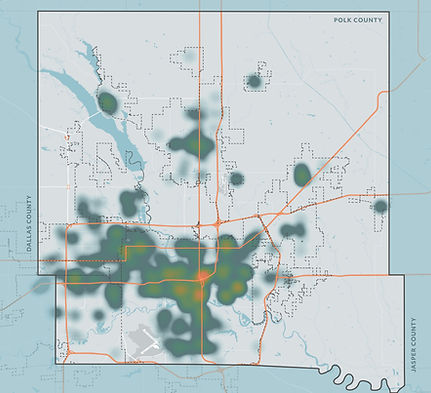
We used several techniques to filter thousands of potential property parcels where housing could be developed. The map shows that locations identified by our process can be found across Polk County.
Grouping sites into typologies
Our land analysis examined hundreds sites across Polk County that meet basic expectations to be suitable for redevelopment as housing. We looked for common characteristics among those sites and identified 10 typologies to create as example sites of opportunity.
-
Faith based infill development, greenspace
-
Faith based infill development, parking lot
-
Undeveloped publicly owned land
-
Standalone or excess parking infill development
-
Aging commercial or retail, medium
-
Aging commercial or retail, large
-
Chronically vacant office buildings
-
Chronically vacant office parks
-
Undeveloped flagpole lots
-
Greenfield land assembly opportunities
Sites of opportunity are meant to spark conversation about what is possible using realistic examples informed by real locations in Polk County, Iowa. However, control of local properties lies with their owners, and the typology examples are not meant to represent or imply development plans for any specific location.
What housing could be developed at sites of opportunity?
Example: New housing on green space at a faith-based site
One potential development example in the Housing Sites of Opportunity report focuses on addition of housing to what is currently open green space on property owned by a faith-based organization. Faith-based organizations are beginning to consider developments like this in a movement called YIGBY or "Yes in God's Back Yard."
The development example shown adds twelve new housing units in a cottage court.
Check out more examples of what is possible at Sites of Opportunity by downloading the full report.

This example includes a cottage court with 12 new housing units. Each 875 ft2 unit costs an estimated $154,000 to build, not including land.
More frequently asked questions about Housing Sites of Opportunity
FAQ: Housing Sites of Opportunity
Recent program news


What happens next?
The final section of the report discusses policy considerations such as building codes and zoning requirements that can unlock the potential of Housing Sites of Opportunity.
If you are a property owner or community member interested in learning more about bringing housing to locations near where you live, contact PCHTF through email to info@pchtf.org.